Showing posts with label Bavaria. Show all posts

Sunday, January 10, 2010

The Little Known Difference Between Germans & Danes

Parts of Germany, the more Catholic parts, hold their own holidays.  If you are a German, especially if you are a German Catholic, or a Catholic German, you already know this.  You don’t need no stinking signs on the doors of the town hall, the bakeries, the banks, the small appliance stores, the insurance / investments office, the travel office, the knick-knack store, the antique store, the DHL / paper goods store, and especially not on the discount grocery store to which I walked in the freezing cold on a Wednesday late afternoon.  Since it was Wednesday, I already knew – from previous abortive trips into the Alstadt – that most of the aforementioned shops would not be open.  The Germans, bested only by the French, I believe, seem to think that working 2 and ½ days is sufficiently taxing to grant them a half day off before they have to put nose to the grindstone for another 2 and ½ days.  Wednesday afternoons (and nearly as often Friday afternoons) belong to the folk! 
Heilige Drei Könige, otherwise known as Epiphany, is annually celebrated in parts of Germany on January 6 to mark the three wise men’s visit to baby Jesus.  This day also marks the end of the 12-day Christmas season.  Christians all over the world observe Epiphany.  It is worth noting that when certain Germans – and they know who they are – observe Epiphany as gesetzliche Feiertag, a  public holiday, they are in no small way reasserting the separatist attitude that pervades Germany as a whole and is an elemental aspect of the country’s history best evidenced by the survival of the Federal States as distinct entities.  (Be warned:  This next section is a self-indulgent digression.  Okay.  So the US has a few quirky residual state loyalties, too.  When someone from The South wears a gray uniform and waves a Confederate flag– just for fun, don’t you’all know - they aren’t all that different from the Bavarians dressing up in their Trachten.  I recently saw a boy riding a bicycle in front of the church situated on one of the two short streets that make up St.Wolfgang who was using a cushion covered with the Bavarian flag on his bike seat.  It seems to me that I have seen kids in the South putting Confederate flags to the same use.)
Germany is a Federal Republic consisting of sixteen states.   Epiphany is celebrated only in the German states of Baden-Wuerttember, Saxony-Anhalt, and Bavaria.  Mariä Aufnahme in den Himmel (mostly referred to as Mariä Himmelfahrt) is celebrated on August 15 in only two federal states in Germany:  Bavaria and Saarland.  Buß- und Bettag, the Day of Repentance and Prayer, is observed only in the German states of Bavaria and Saxony, and it a holiday of the Evangelican Church.   Starting to get it?   As you may have suspected about now, Bavaria observes every German religious holiday.  Now I understand why I can greet Germans in this southern village with the traditional Bavarian greeting of Gruß Gott and have them always respond with more than a nod or a grunt, despite their squinty-eyed stares indicating I am not to be trusted and that they know I am probably just masquerading as Catholic. 
Pause here with me for a moment to reflect again on the Day of Repentance and Prayer.  In Denmark, this holy day is called Store Bededag and it is s also a statutory Danish holiday.  The Danish don’t make much statutory, but when they do, it is generally based on the soundest sort of linear reasoning.  For instance, legend has it that when the Nazis demanded that Danish Jews wear stars during the German occupation of Denmark, King Christian X said that all Danes would wear stars.  From what I have learned about the German psyche, this was only permitted because a rule, as any good German knows, is a RULE.  This story gives you, dear reader, a rare glimpse into the mind of a Dane.  Keep it simple - and we don't just mean Danish modern...With the same sort of cut-to-the-chase attitude as his predecessor, King Christian V introduced Store Bededag as a holiday in the Church of Denmark in 1686; he saw it as a collection of minor (or local) Roman Catholic holy days consolidated into one day.  The Church of Denmark has observed this tidy holiday since the Reformation; with typical Danish informality, they have come to call it General Prayer Day, All Prayers Day, or Common Prayer Day.  With our 21st century knowledge about mergers & acquisitions, most of us would expect a few Saints to be miffed; Saint…CEO…lose your 15 minutes of fame, it must feel pretty much the same.

Sunday, October 11, 2009

Bill Bryson, Won't You Please Come Home - To Bavaria

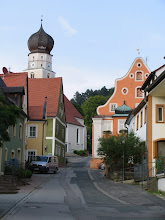
By now, it is clearly evident to the reader that I was raised Protestant, or some such, because it took me so very long - despite my indefatigable quest for knowledge - to recognize the Epiphany practice of the blessing of homes and churches and just about any other structure, apparently. (In my home, we always felt that the house was blessed if we could pay the light bill – illumination being a form of grace.) So it won’t surprise you, then, to learn that I was also flummoxed by the number of churches scattered across these Bavarian Jurassic Park-like hills. The Baroque churches, which look like miniature Orthodox structures, are easy to spot as they are mostly all capped by comfortable-looking onion tops, not unlike what persists over the top of my belted jeans. The Baroque style of construction was a response to the Protestant reformation and the sense that the Church’s architecture could be more emotionally accessible to the people, (In my experience, cabbies in New York City, capably filling the silence as they crawl along 5th or Madison Avenue past St. Patrick’s, will say the very same thing) all the while conveying the wealth and power of the church. Quite effectively, like kindred minarets in the Muslim world, the church spires point heavenward while conveying a sense that Big Brother (literally, fratres) has his eye on the village imbibers from a rather terrific vantage point. Looking across the high moors that make up the Upper Palatine plateau, the only structures that seem to be as prominent as the churches are the breweries, or the places in which one consumes the products flowing out of the breweries. Now it occurs to me (as it probably did to you if your college years were similar to mine) that there is an inherent difficulty in having an equivalent number of taverns and churches in a small town. The good news, here, is that there is a church within walking distance of every neighborhood in the village, an attribute one can particularly appreciate if one’s spouse insists that one is still – after last night - not in a state to take the family car on Sunday morning. No more than about two dozen parishioners can fit in one of these neighborhood churches. An empty spot in a pew would stand out like a sore thumb and, perchance, encourage the priest to head for the doorstep of the budding scofflaw. The company you’re likely to keep while doing your part to ensure the perpetuity of German drinking songs is also the company you’ll see when you slip into your pew - or not - on Sunday. That feeling of brotherhood conveyed by the motto, Einen fur alle, alle fur einen, in letters 12 feet tall on the sides of the breweries, conceivably was fostered by the Saturday night practice of Ale fur alle und alle fur ale. The sense that “we are all in this together, boys, so get your stories straight” would not be lost on der Volk.

The villagers were not seeing me in church so, to counter this, I was doing my best to make appearances wherever there was beer. The problem was, even when direly thirsty, I couldn’t make my way to the bottom of a typical German beer glass, not to mention a decent-sized stein. My posing lacked authenticity. It was as though every passing German could tell that I would prefer a twinkling little glass of St. Germaine to a cloudy wheat beer with a banana aftertaste. I wasn’t winning friends or, for that matter, drinking buddies.
My daughter, who looks Italian or Turkish (note that Germans are not particularly fond of the Turks who flooded into their country after the war and made good livelihoods from the rebuilding efforts, or Italians - you know that story), had warned me that Germans tend to stare openly at strangers. I suspected this practice might be exaggerated in a village where everyone knew everyone else (having shared Saturday night fever, doubtless followed on Sunday morning by mildly aching heads, the suffering made slightly more acute by shoulder-to-shoulder pious kneeling). I thought I’d have a better time of it, given that, with my blue eyes and blonde hair, I look more German than most of the nationals I was seeing. But, this was not to be. I collected blank stares left and right, regardless of my open, smiling, American demeanor (which, roughly translated in Bavarian, apparently meant “simple minded”).
Historian Michael Sturmer had written that German diversity stems from differences in “bread and beer, in customs, language, and the local law.” To this list, I would add religion, and preferences regarding the local wurst. (Long-standing competition regarding regional production of a signature wurst is taken very seriously in Germany and has uncannily elevated the sausage to gourmet status.) How, then, might the Badeners or Prussians differ from the Bavarians? I wondered if this reserved (read: aloof) attitude was Bavarian or just small town? After meeting a couple from Munich on the trail to my village’s very own castle ruins, I lean toward the small town explanation. With virtually no one else on the trail (a condition I’ve come to believe is more common than not because, these are really truly just ruins, with no colorful souvenir shops or re-enactments or traditionally dressed guides), the couple from Munich ecstatically hailed me, and hearing my accent, asked me if I was from California. Not wanting to disappoint them, I said I was, and felt very much like I’d been added to a list like kids who “call” the states of license plates on a very long road trip. The couple, a mother and her apparently dutiful grown son, told me they were on a “castle tour all over,” and then enthusiastically shared with me their colorful brochure describing Hitler’s stomping grounds in a nearby town. I wondered if they would later attach little castle pins to their woolen Tyrolean hats – one for each castle visited and one very special one for the Eagles Nest. Later that afternoon, as their car careened down the cobbled street of the village – one leg of the castle tour apparently completed - they honked wildly and, upon seeing me, hollered something that sounded like “California, here we come.” From where I sat on the terrace of a local establishment, I raised my glass of (unfinished) liquid golden sunshine in return.
In most countries where there is a definite north and south sensibility, those in the other region – which is wherever you are not - seem often to be described by a string of words meant, to some degree or another, to be disparaging - pejorative terms marking them as the “other.” Though dated, Thomas Mann’s Buddenbrooks, provides a good example which is not too far from what one might find implicit even in the language of modern guidebooks. In Mann’s story, a woman born in the north marries a Bavarian but still doesn’t think much of the easy going southerners, describing those from Munich as “without dignity, morals, energy, ambition, self-respect, or good manners” in contrast to those from the north, where “people work and get things accomplished and have a purpose in life.” With these thoughts in mind, I entered the local bank after waiting for it to reopen following an hour and a half lunch break, and contemplated a crucifix on the wall just behind the bank teller. A bank employee returning a little late from lunch hurriedly greeted her co-workers. “Goose got.” “Got what?” I wondered. What could a goose get that one would think important enough to use as an excuse for being late to clock in? And everyone seemed to already know what the goose had gotten because they all just nodded at her, and looked warily at me as though I truly was the village idiot. Unbeknownst to the tellers, I had to walk past a formidable gaggle of geese on my way to the bank, and I appreciated fully that “being gotten by the geese” would not make for a very happy lunch break. The very next day, from behind her low fence along our street, an older woman looked up from her gardening and murmured the same thing - Gruß Gott – and actually smiled at me. In a month’s time, this was the first spontaneous smile that I’d received from a national, other than shopkeepers who gleefully accepted Euros from me (for a .52 on the dollar exchange rate, well they might).

Emboldened by the beer-garden familiarity of the Munich Volk encounter and figuring it worked for the bank teller, I reasoned; why not try to divert my fellow villagers with a hearty southern-style greeting. So I met the stares of the people with narrowed eyes and pinched mouths with a warm smile and a singing “Gruß Gott!” Religious folks everywhere tend to be a bit superstitious, presumably covering their bases - just in case. To ignore someone saying “God bless you” might be living just a tad too close to the edge. Whether because of reflex or a reluctance to invoke dark spirits, villagers on the street greeted me in return. Perhaps I could not so easily unloose my casual American joie de vivre in northern Germany, however, where there are fewer Catholics. Saying “God greet you” to a Berliner is likely to elicit an amused “Not too soon, I hope!”

Decoding Bavaria

Had it not been very late on a moonless night when I stepped across the threshold at the Bavarian house for the first time, I know I would not have missed the writing in chalk over the door. As it were, I did not truly see the outside of the house until the next day, when I ventured out, where I stood relishing the warmth of the sun and enthusiastically inhaling air freshly scrubbed by a nighttime storm from the Alps. After testing my legs during a brief walk on the cobbled streets of the Markt, I found my way back to the house and where I came to an abrupt halt.


For many people, white chalk conveys happy thoughts. Childishly drawn hop-scotch boxes. Sidewalk chalk art contests. Enticing specials of the day written in tidy script on sandwich boards in front of quaint restaurants. At the right age, getting to be the envied cleaner of a classroom chalkboard. The white cliffs of Dover. Other chalky memories may not be so pleasant. What university freshman – trying to blend like a chameleon into the dark oak seats of an ancient auditorium – has not suffered while a hard-of-hearing professor nearing emeritus status inadvertently drew a piece of chalk across a slate surface at the just the perfect angle to create an agonizing screech? Or, for instance, who has not come suddenly upon a star and circle pentacle sign surreptitiously scrawled behind the bathroom door when visiting a relative? Well then, lucky you.

Staring at the chalky writing over the door, my first thought was to wonder who had lived in the house before we moved in. My second thought was to wonder if there were any lingering, shall we say, emanations.
                +
20 + C + M + B + 09
Probably an algorithm some carpenter feared he’d forget lest he write it down immediately. Like the phone number that you repeat over and over until, at last, you find paper and pencil. Harmless. Endearing, even, as only the absent-minded sometimes are. Must write it down. Imagine Mr. Magoo with Altzeimer’s.
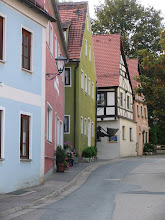
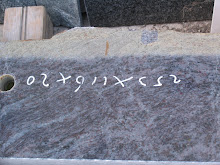
The next day, I cheerily followed the winding streets into the Altstadt, the old town. My brain eventually grew used to the colorful house-fronts edging the narrow streets and the lexicon of hanging wrought-iron signs indicating the shop trades. The gradual familiarity let me begin to pick out details, like what happens when you twist your camera lens aperture for a close up. Emulating Hansel & Gretel deliriously following their breadcrumbs, I began to pick out chalk letters and numbers everywhere in the village. Here, written across the middle of the Bäckerei (bakery) door. There, written on the top rail over the door to Apotheke, the drugstore. And at my feet, on a polished granite lintel placed incongruently among the headstones-to-be-engraved at the stone memorial workshop, apparently awaiting eventual placement in some prestigious - or sanctified - spot.

In my jet-lagged clarity, I decided the numbers must be part of a surveying project. My truly flimsy theory fell away when I saw that the very same number 20 + C + M + B + 09 appeared everywhere in the tiny town. After a few days of sleuthing, I had ranged further afield and saw that only the first number changed, if that. And in the dusky depths of a restored cathedral, I discovered the chalk inscription on an interior door. Okay, so not-a-surveyor’s-mark.

A few cursory search attempts on my laptop didn’t solve the mystery. I had begun to feel like the Klinsky family in Manhattan whose playful architect, Eric Clough, unbeknownst to them, embedded a scavenger hunt into his renovation of their 5th Avenue apartment. For months, the bemused family stumbled on ciphers, secret doors, mazes, puzzles, and games until the creative (and, let’s guess, well entertained) architect at last owned up. Still bedeviled, I tried yet another internet search; my life was illuminated by Flickr and I fell to my knees in front of a posted photo of a priest blessing a house - in Bavaria, no less. The priest had, the caption read, just used the blessed chalk (Who knew?) to write an inscription intended to bless all those who entered and departed through the door. God bless Google.

Like in any good code, the letters in the inscription can have more than one meaning. I learned that the letters C, M, and B are the initials of the traditional names of the Three Magi: Caspar, Melchoir, & Belthasar, and also abbreviate the Latin words Christus mansionem benedicat, which means “May Christ bless the house.” The plus signs are intended to be crosses representing the blood of Christ and the holiness of the magi. So far, we have C + M + B. This christening of the home occurs during the month of January and is a nod to the Roman God Janus, whom some of you may recall is the doorkeeper to Heaven and the beginning and end of things (quite a lot to be responsible for, at the end of the day - or the end of time, whichever came first for Janus). The initial number indicates the day in January when the blessing was given. The ending number is the year which, given that the inscription is written in chalk, hardly seems necessary. Since I never saw any cross-outs of previous years, it seems reasonable that at some point, probably on the German equivalent of Boxing Day, that the evergreen swags hanging over front doors come down, and a very special (perhaps even blessed) sponge (one might guess, sated with Holy Water) is used to make a clean slate, ready, as it were, for the new year’s Epiphany inscription. Last - and this may help me overcome any disfavor I feel toward chalk - the inscription, in its entirety 20 + C + M + B + 09, is written in chalk since chalk - being of the earth - represents Christ in human form. This last part probably accounts for the additional cross sometimes written over the letter M - a crowning cross, it would seem.

Upon reflection, given the range of house blessings practiced the world over, I considered myself lucky. And I thought that the Klinskys should be grateful, too, that the distinguished Mr. Clough was not enamored with the Moroccan manner of house blessings, whereupon small animals are ritually sacrificed and walled up in the new construction. Singularly, such a practice could hasten the speed (given most months in Morocco can be quite warm) at which an impromptu house-warming scavenger hunt shapes up.